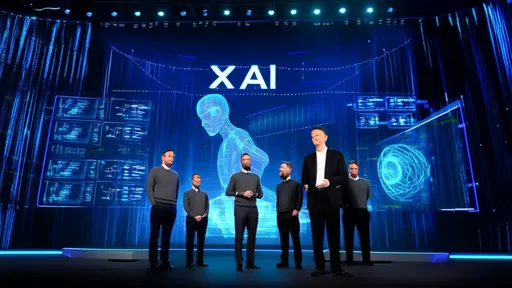
In a bold move that could redefine the landscape of artificial intelligence, Elon Musk's xAI has announced its latest project: a "Super Reasoning AI" designed to outperform even the yet-to-be-released GPT-6. The revelation came during a private tech summit in Austin, where Musk outlined his vision for an AI system capable of advanced logical reasoning, contextual understanding, and problem-solving abilities that would leave current models in the dust.
The announcement sent shockwaves through the AI community, particularly given Musk's complicated history with OpenAI, the organization behind the GPT series. Industry analysts immediately began speculating about the potential implications of this new project, with some suggesting it could trigger another AI arms race among tech giants. Musk, never one to shy away from ambitious timelines, suggested that xAI might have working prototypes within the next 18 months.
Pushing Beyond Language Models
What sets xAI's approach apart, according to insider sources, is its focus on creating AI that doesn't just process information but truly understands and reasons with it. While current large language models excel at pattern recognition and text generation, they often struggle with deeper logical consistency and factual accuracy. The Super Reasoning AI aims to bridge this gap by incorporating novel neural architectures specifically designed for complex problem-solving.
Early technical documents suggest the system will combine the strengths of transformer models (like those used in GPT) with more specialized reasoning modules. These modules would handle different types of logical operations - from mathematical proofs to causal reasoning - while maintaining the fluid language capabilities users expect from cutting-edge AI. The integration of these systems represents a significant engineering challenge that xAI's team of researchers, poached from top AI labs worldwide, is currently tackling.
The GPT-6 Benchmark
Musk's explicit targeting of GPT-6 as the benchmark for his new AI has raised eyebrows, given that OpenAI has only officially released GPT-4. However, industry insiders suggest that internal development at OpenAI is much further along than public releases indicate, with GPT-5 likely nearing completion and GPT-6 already in early development stages. By aiming directly for what might be considered two generations ahead of current public technology, xAI is making clear its intention to leapfrog rather than incrementally improve upon existing models.
The competition between these two visions of AI development - OpenAI's gradual, safety-focused approach versus xAI's aggressive push for capability - may shape the entire field in coming years. Some experts worry this could lead to reduced emphasis on safety measures in the race for supremacy, while others argue that such competition is necessary to drive meaningful progress in what has become a somewhat stagnant landscape of minor model improvements.
Technical and Ethical Challenges
Developing an AI system that genuinely reasons rather than just statistically predicts text raises numerous technical hurdles. Current AI systems, for all their impressive capabilities, don't truly "understand" information in the way humans do. They identify patterns in vast datasets but lack the underlying cognitive structures that enable human-like reasoning. xAI's approach would need to somehow bridge this fundamental gap while still maintaining the scalability that has made deep learning so successful.
Ethical concerns also loom large. A super-reasoning AI could potentially be far more powerful - and potentially dangerous - than current systems. Musk has stated that xAI will implement "unprecedented safety measures," though details remain scarce. The company has reportedly been in discussions with various governments and regulatory bodies about appropriate safeguards, suggesting they're taking these concerns seriously even as they push forward with development.
Potential Applications and Impacts
If successful, a super-reasoning AI could revolutionize fields ranging from scientific research to legal analysis. Imagine an AI that doesn't just summarize existing studies but can propose novel hypotheses and design experiments to test them. Or a legal assistant that doesn't merely retrieve relevant case law but can construct original, logically sound arguments. The economic implications alone could be staggering, potentially automating entire categories of high-skill jobs that were previously considered safe from AI disruption.
However, the path to such capabilities is fraught with uncertainty. Previous attempts to create AI with advanced reasoning capabilities have often run into fundamental limitations of current approaches. Some researchers question whether the proposed architecture can truly deliver on its promises or if it will simply become another variation on existing large language models with marginal improvements in reasoning ability.
The Road Ahead
xAI faces a daunting task in its quest to surpass GPT-6. The company must not only solve numerous unsolved problems in AI research but do so while navigating an increasingly complex regulatory environment and intense competition from better-funded rivals. Musk's track record with ambitious technological ventures suggests that counting xAI out would be unwise, but the challenges are substantial enough that many experts remain skeptical about the project's timeline and ultimate success.
As development progresses, the AI community will be watching closely to see whether xAI can deliver on its promises or if the Super Reasoning AI will join the ranks of other ambitious but ultimately unrealized AI projects. One thing is certain: the announcement has reignited debates about the future direction of AI development and what constitutes true artificial intelligence - debates that will likely intensify as both xAI and OpenAI push the boundaries of what's possible.

By /Aug 14, 2025

By /Oct 20, 2025

By /Aug 14, 2025

By /Aug 14, 2025

By /Oct 20, 2025
By /Aug 14, 2025

By /Oct 20, 2025
By /Aug 14, 2025

By /Oct 20, 2025

By /Aug 14, 2025

By /Aug 14, 2025

By /Oct 20, 2025
By /Oct 20, 2025

By /Aug 14, 2025

By /Aug 14, 2025

By /Aug 14, 2025

By /Oct 20, 2025

By /Aug 14, 2025

By /Aug 14, 2025
